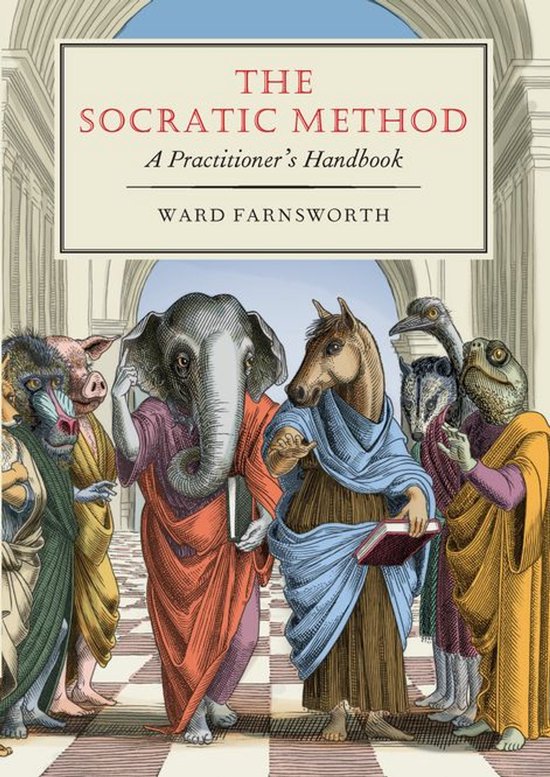
The Socratic Method
Reflection: This book introduced me to the Socratic Method, a form of dialogue in which a person questions a conversation partner on a topic until a partner reaches a conclusion, or their reasoning breaks down and they are forced to admit ignorance.
At the core of the Socratic Method lies the Elenchus, a dialectic "device" or procedure often used by Socrates in Plato's dialogues to test the claims and beliefs of his conversation partners. It usually goes as follows:
- A conversation partner puts forward a claim
- Socrates leads them to accept a further, related proposition.
- He then shows that this new proposition conflicts with the original claim.
- The conversation partner recognizes that their initial claim is inconsistent, incomplete, or false.
- They attempt to revise or refine the claim.
The Elenchus's main purpose is to show that a person does not fully understand the implications of their own position, or that they do not actually believe what they claim to believe. It is a method for refuting claims and it cannot by itself establish positive truths. Claims that cannot withstand scrutiny collapse under their own commitments. However, a claim's resistance to refutation does not necessarily mean that it is true, since it may simply be that “Socrates” has not been able to uncover a contradiction.
While it looks like the method is only used to tear down claims, it can also be used to defend an idea. It can fend off challenges to a claim by showing that alternative positions collapse into contradiction when examined. This does not make the defended claim true, but it can show that competing views fare worse. While this may sound unexciting (and requires a lot of work) it can be used to identify ideas that resist refutation, in a sense aligned with Karl Popper's notion of falsification.
One side effect of using this method is that it can leave a person in a state of aporia ("without passage"): a condition of puzzlement or internal conflict. This occurs when every attempt to state something true has been refuted, leaving the person unsure what to think at all. Someone who was previously ignorant of their ignorance now sees it clearly, their supposed knowledge falls away. Socrates does not treat aporia as the end goal, but as the beginning. Good, you realize that you know nothing. Start searching.
It is interesting to see that the Socratic method is later borrowed/used by the Skeptics and the Stoics.
Skepticism takes over Socratic questioning and treats wisdom as knowing how little one knows. The skeptics thought this was best achieved through constant questioning and by seriously considering both sides of an argument. When opposing views seemed equally strong, they introduced epoché, the suspension of judgment. This is not denying a claim, but refusing to commit to it. They were cautious about what could be known and even doubted that things like Stoic virtue could be known with certainty.
Stoicism takes a different lesson from Socrates and develops it into a rival approach. Thinkers like Epictetus held that the first task of philosophy is to give up self-conceit, and they believed reason could lead to firm truths about how to live. Epictetus uses the Socratic style not to suspend judgment, but to challenge ethical assumptions and improve character. For the Stoics, the Socratic method is something to internalize, aimed at virtue and a clear sense of what truly matters.
The book took me a long time to finish, partly because it was difficult at times and partly because I did not always enjoy the writing style. My main take-away is the elenchus and its function. If properly used I think it can be an antidote to ignorance and therefore helps prevent dogmatic thinking. It encourages the constant re-evaluation of what you know and I therefore agree with the Stoics that applying it to yourself (even if this is very hard) can help you improve your character. It also keeps one humble by realizing that one knows very little. This is something a lot of people would benefit from.
Overall, I enjoyed the book quite a bit.