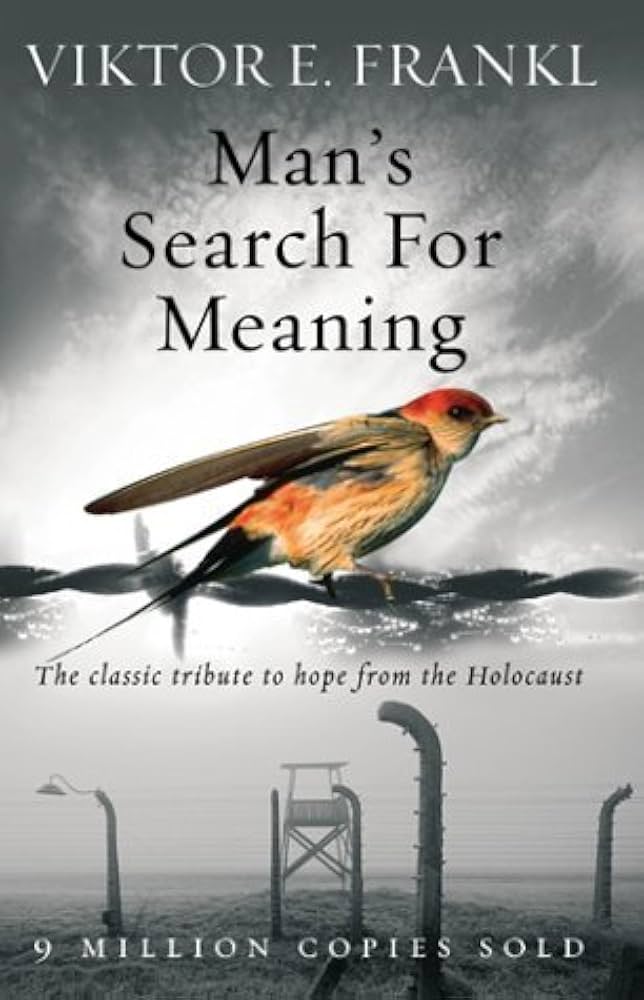
Man's Search For Meaning
Reflection: This book is about Viktor Frankl's experience in Nazi concentration camps, and describes the gruesome details of Jews in such a camp and how they fared (or didn't).
Throughout the first part of the book he describes the horrible conditions of the "inmates" and what this did to their psyche. The ones that fared the best, were inmates who were hopeful and had something to look forward to. These inmates were able to find (or already had) meaning in a situation barren of any enjoyment (Nietzsche: "He who has a why to live for can bear almost any how").
Others did not fare so well. Frankl describes this grimly by explaining how he could tell whenever someone has lost hope (or meaning), as they would spend all their belongings on the comfort of a final cigarette and then simply stop eating and cooperating and would eventually die.
The second part of the book is about his school of psychotherapy called Logotherapy, which is built on the idea that the primary human drive is not pleasure or power but meaning. According to Frankl, meaning can be found through creative work, through experience and love, and through the attitude we take toward unavoidable suffering. Frankl also thinks that meaning is specific, not abstract. He insists there's no general answer to what the meaning of life is, as meaning differs from person to person and even from moment to moment: life questions us, not the other way around. This connects well to my reading of Existentialism (Sarte, Camus).
A paragraph I liked:
"An active life serves the purpose of giving man the opportunity to realize values in creative work, while a passive life of enjoyment affords him the opportunity to obtain fulfillment in experiencing beauty, art, or nature. But there is also purpose in that life which is almost barren of both creation and enjoyment and which admits of but one possibility of high moral behavior: namely, in a man's attitude to his existence, an existence restricted by external forces. A creative life and a life of enjoyment are banned to him. But not only creativeness and enjoyment are meaningful. If there is a meaning in life at all, then there must be a meaning in suffering. Suffering is an ineradicable part of life, even as fate and death. Without suffering and death human life cannot be complete."
Here Frankl suggests that suffering itself can be meaningful and gives one the possibility of truly high moral behaviour.
My takeaway from this book is that finding meaning in my life is essential. How this meaning will be filled in for me, is yet to be decided (perhaps by me). But as a determinist I cannot yet fully embrace Frankl's framework.
Frankl argues against "pan-determinism", i.e. we are conditioned by biology, psychology and circumstance but we remain free to choose our stance towards those conditions. I find this idea unconvincing, since the choice of a stance is itself determined. I have the same issue with the existentialist idea of creating my own meaning. In both frameworks it boils down to making a choice, but I believe that this “choice” is itself governed by factors outside of my control.